

In this Issue
- Detecting Frost Damage
- Codling moth: first generation spray dates provided for a few northern Utah locations for early May
- Apple powdery mildew: if a problem in the past, treat after bloom is over
- Peach powdery mildew and Coryneum blight: if a problem in the past, treat at shuck-split stage and repeat
- Green peach aphid: damage is visible now
Detecting Frost Damage

On the morning of April 3, some areas of Utah dipped down to 25F, which is cold enough to kill 90% of flowers and developing fruitlets. Other areas, however, did not go below 30F, so trees there will not be damaged.
Sometimes a freeze will damage only a part of the flower or leaves, and the developing tissue becomes deformed. Buds occurring lower in the tree canopy are more susceptible to damage or death than those higher up.
There is a way to tell if flowers or fruitlets have been damaged:
- Wait about 3 to 7 days, and then check flowers and fruitlets for inspection.
- Select 2 to 3 flowers from each of the lower and mid tree canopy (so around 6 flowers per tree) and split them evenly down the middle.
- Look for brown or black plant tissue within; this indicates death.
- Healthy tissue will be greenish or creamy yellow in color.
If a significant portion of the crop appears to be damaged, wait to make a final assessment a few weeks later when fruits should start developing to determine a plan of action for the season. Decisions would need to be made about whether to invest funds in pest management, nutrition, and other practices. Please contact USU Extension if you need to discuss.
APPLE, PEAR
Codling Moth
Dates (a month from now) provided for a few northern Utah locations
Click here to view a pdf of the spray timing table. Please read the instructions at the top of the page, for how to understand the table.
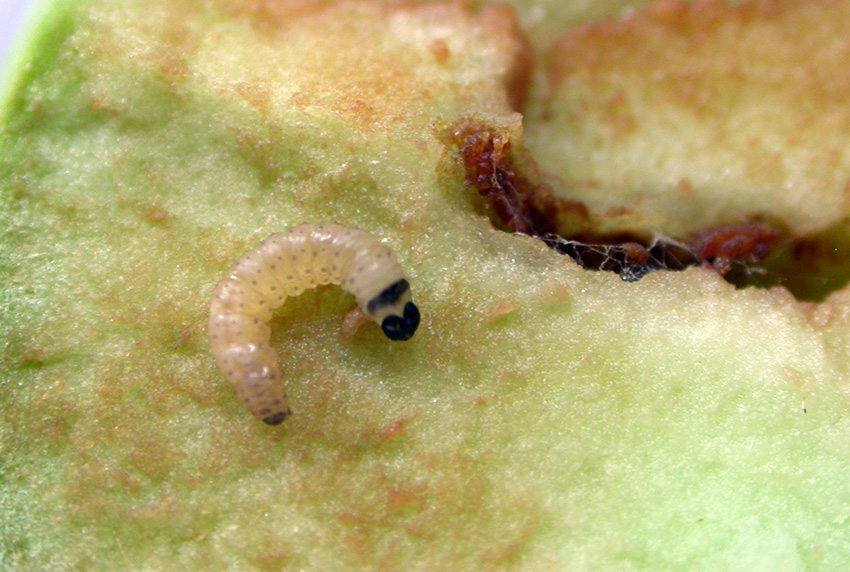
Codling moth is a pest that needs to be treated all season long for clean fruit. Moths lay eggs on fruit, and the larvae tunnel in and feed on the seeds of the fruit for about 5 weeks. They then pupate into a moth to form the second generation of larvae in early summer.
For most locations in northern Utah, we do not have any data yet on the timing of treatment. And for the others, the timing is currently about a month away. An updated table will be generated for the next advisory that will be more accurate. That advisory will also include more information on managing this pest.
Not all Utah locations are provided on the table. To remedy this, either select your closest city on the table, or, go to the Utah TRAPs website, select your city on the map, and select “Codling Moth-Fixed Biofix” from the Pest drop-down menu on the right.
Treatment Options
Commercial growers: click here
Residential: See the table below. It is important to know how long your spray application will last. For the product you are using, check the “active ingredients” on the front label of your product (in small print on the lower right or left of the label). Sometimes there are several ingredients, sometimes, just one. Some materials last longer than others, and the time between sprays is not always listed on the label.
| Product Name | Efficacy | Residual Length (days) | Comments |
|---|---|---|---|
| CONVENTIONAL | |||
| Spectracide Triazicide (gamma-cyhalothrin) | Good to Excellent | 14-17 | wait 21 days to harvest |
| Monterey Bug Buster 11 (esfenvalerate) | Good to Excellent | 14-17 | wait 21 days to harvest |
| Bonide Fruit Tree & Plant Guard (lambda-cyhalothrin) | Good to Excellent | 14-17 | wait 21 days to harvest |
| Bonide Malathion; Hi Yield Malathion | Good | 5-7 | max 2 applications; some products are pears only |
| GardenTech Sevin (zeta-cypermethrin) | Good to Excellent | 14-17 | wait 14 days to harvest |
| ORGANIC | |||
| AzaSol, EcoGarden (azadirachtin) | Good | 7-10 | purchase online |
| Cyd-X (codling moth virus) | Good (if populations are low) | 7 | works best when used at beginning of generation; expensive and purchase online |
| oil such as All Seasons Oil, EcoSmart, Neem oil | Good on eggs only | 3 | recommended for first application of the generation only |
| Ortho Fruit Spray; Fertilome Fruit Tree Spray; Safer End All; Bonide Orchard Spray (all contain pyrethrin) | Good | 3-5 | |
| Monterey / Fertilome Spinosad; Captain Jack's Deadbug Brew; Natural Guard (all contain spinosad) | Good | 10 | max 6 applications per season; if applying to peach or cherry, can re-apply after 7 days |
Apple Powdery Mildew
Apply fungicide after bloom
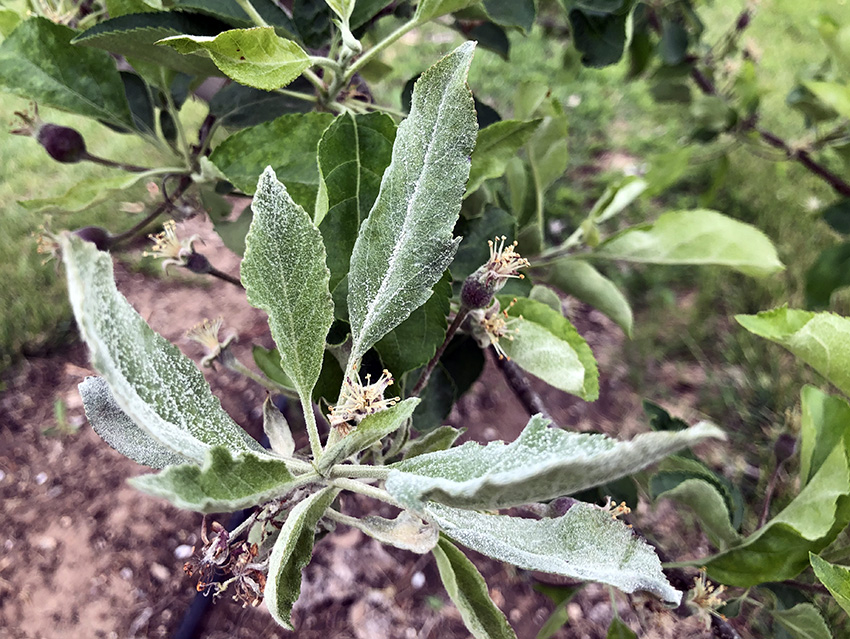
Apple powdery mildew overwinters on twigs, and Utah’s warm winter of 2026 resulted in good conditions for survival of this fungus. We usually start to see new infections soon after bloom.
Ideally, foliage should be protected before the fungus has a chance to cause disease. If left untreated, new infections can occur all summer long, just from humidity within the tree canopy.
If your apples have had powdery mildew in the past, it will likely have it this year, as well. Consider a fungicide application after bloom is fully complete, with a second application about 5 to 14 days later, depending on the product used (see below).
Cortland, Idared, Gingergold, Braeburn, Gala, and Jonagold are all varieties that are more susceptible.
Treatment
Commercial growers: treatment options are shown by clicking here. For each product, there is a range of days after the treatment name that shows how long the protection interval lasts.
Residential growers can use:
- Spectracide Immunox or Monterey F-stop: separate the applications by at least 14 days and after that, apply as needed
- Sulfur (organic; many brands): apply every 10 days as needed
- Neem oil or 1% horticultural oil (organic; many brands): apply every 3 to 5 days as needed, but not when temperatures will reach 85 F within 4 hours of application
- Potassium bicarbonate (organic; Monterey Bi-Carb, Garden-Ville): apply every 7 days as needed
PEACH/NECTARINE, APRICOT
Peach Powdery Mildew and Coryneum Blight
Apply fungicide at shuck split stage
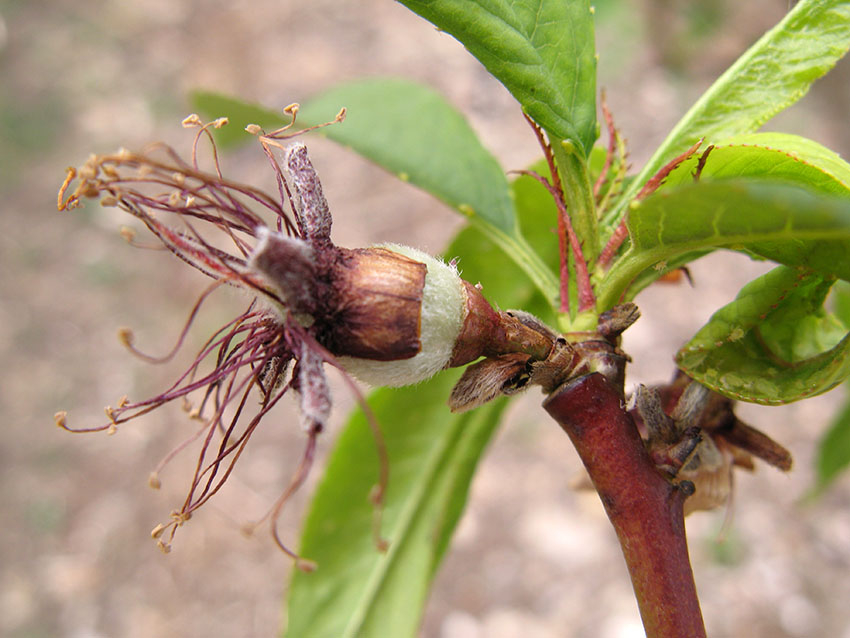
Peach powdery mildew overwinters on roses and sometimes on peach buds and bark. In spring, when nights are cool and moist, and days are warm, spores infect foliage (rarely) and peach fruitlets. On fruit, new lesions look like fuzzy, bright white spots. Fruit infections can occur all spring until the pit hardening stage. (The only way to tell pit-hardening is to slice peaches.) Infections on leaves are typically only seen later in the season.
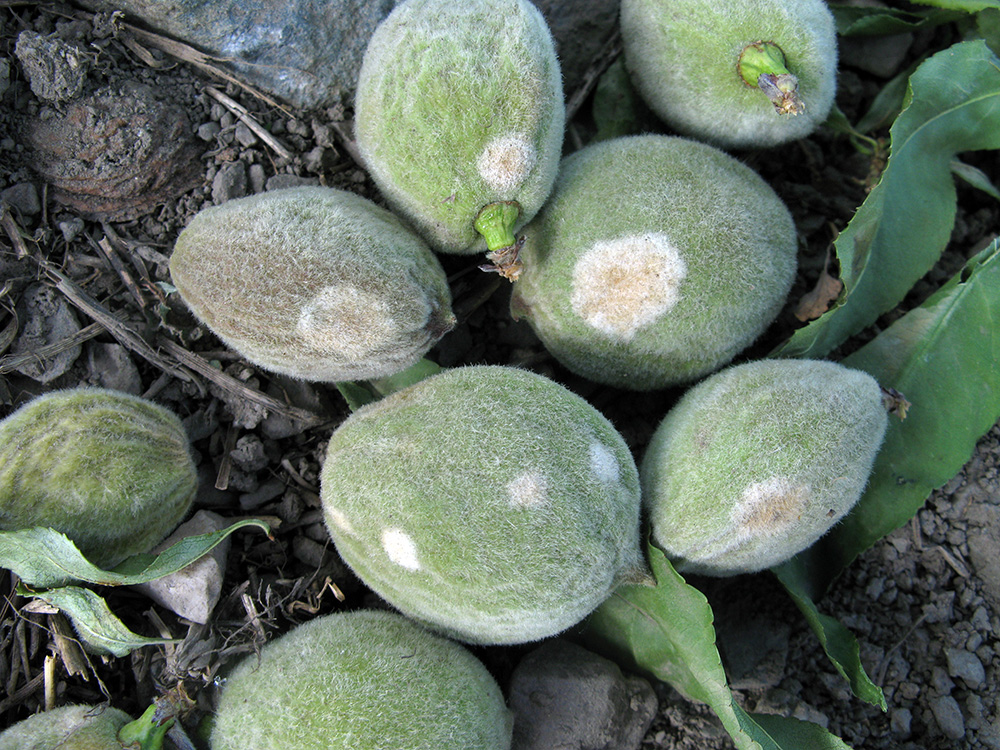
Infections won’t be noticeable on fruit until 2 to 4 weeks after bloom. At that time, monitor 25 fruits on several trees for the presence of round, whitish, powdery spots on the fruit surface. A total of 10 to 20 fruit infections and greater than 20 fruit infections per tree represents moderate and high risk, respectively.
Susceptible varieties include Redskin, Rio Oso Gem, Elegant Lady, Fairtime, Fay Elberta, and Summerset.
The shuck-split spray will also target coryneum blight.
Treatment
Commercial growers – click here.
Residential – chlorothalonil or sulfur (organic); If a fungicide is needed after shuck split, use sulfur, Spectracide Immunox, or Monterey F-stop.
Continue fungicide sprays on susceptible varieties at 10 to 14-day intervals until the pit hardening stage is reached.
Green Peach Aphid
These could be ignored
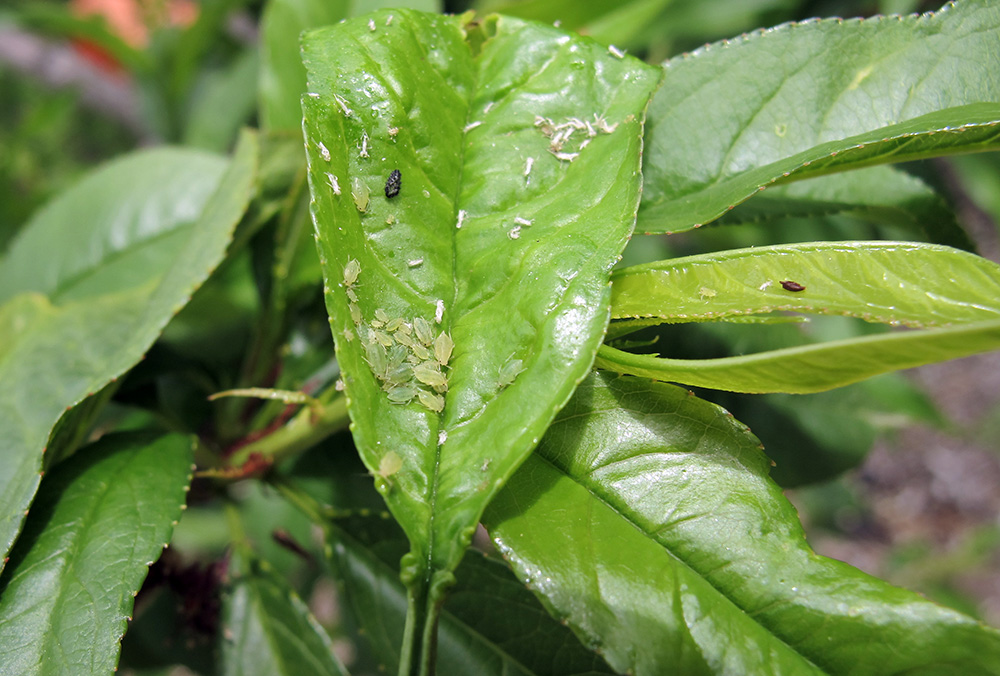
Green peach aphid is a very common pest of peach foliage early in the season. They overwinter as eggs near buds, and a high population survived our warm winter! Areas that had freezing conditions in the 20s on April 2, may see the population decline.
The aphids cause the leaves to curl as they feed, which makes it difficult for an insecticide – whether conventional or organic – to reach the aphids. Some factors to consider when determining whether or not to spray include the following.
- The aphids migrate away from the trees in mid-June or so for other hosts.
- The tree will put out another flush of foliage that will be healthy and not covered by the aphids.
- The aphids are providing food for beneficial predators.
- Because the leaves are so curled, it is hard to get a pesticide spray into the leaves to treat the aphids.
- Most trees can tolerate the damage.
Treatment
- Commercial growers can use Admire Pro (or generic) or Assail.
- If necessary, residential growers can use insecticidal soap, but the soap must come into contact with the aphids, as they soon will be tucked tightly within the leaf curls.