

In this Issue
- Codling moth: first generation spray dates provided for most locations (ignore if fruit is lost)
- Woolly apple aphid: colonies are building; treat this pest even if fruit is lost
- Coryneum blight: rains will cause new infections (ignore if fruit is lost)
- Iron Chlorosis: symptoms visible now; can use a foliar spray
APPLE, PEAR
Codling Moth
Time to treat for most Utah locations; Ignore if fruit is lost
View a pdf of the spray timing table. Please read the instructions at the top of the page, for how to understand the table.
If your fruit was lost to frost, do not spray for codling moth.
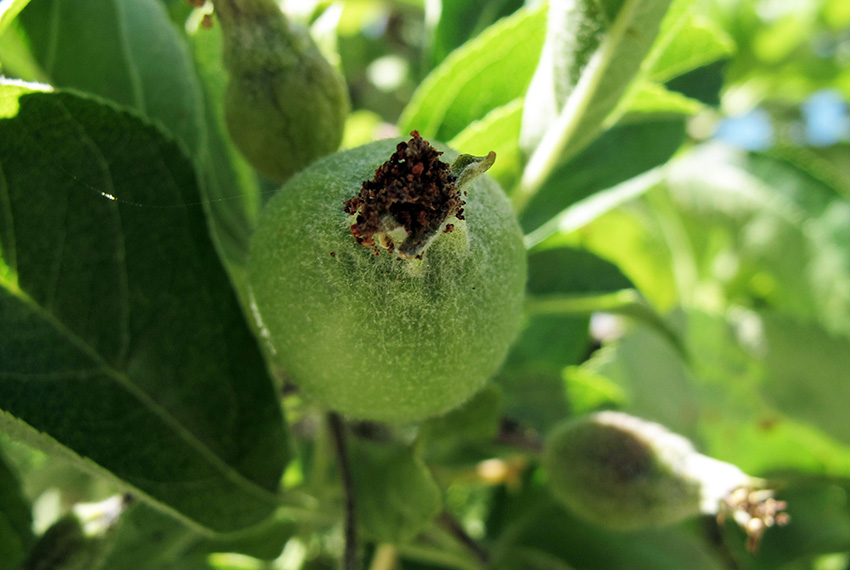
Codling moth is a pest that needs to be treated all season long for clean fruit. Moths lay eggs on fruit, and the larvae tunnel in and feed on the seeds of the fruit for about 5 weeks. They then pupate into a moth to form the second generation of larvae in early summer.
The codling moth treatment timing is coming up in early to mid-May for many areas of Utah. If your location is not on the pdf table, either select your closest city on the table, or, go to the Utah TRAPs website, select your city on the map, and select “Codling Moth-Fixed Biofix” from the Pest drop-down menu on the right.
Additional Information for Application Decisions
For strategies on how often to spray for codling moth, it will depend on whether you are using organic or non-organic options, AND how heavily your apples or pears have been infested with codling moth in the past.
If you have SOME fruit left after the frosts, keep in mind that the fewer the fruits, the greater the chance they will be attacked by codling moth if left untreated.
Conventional production options
- High fruit damage in past years:
- Apply the first application at the start of egg hatch.
- Repeat the spray every 14 days until the end of egg hatch.
- When the “start date” for the 2nd generation is provided (in a future advisory), spray every 10-18 days until Sept. 15.
- Pick a different product to use for each generation.
- Moderate fruit damage in past years:
- Apply the first application at the start of egg hatch.
- Repeat the spray 14 days later for a total of 2 applications for the first generation.
- When the “start date” for the 2nd generation is provided (in a future advisory), spray every 10-18 days until Sept. 15.
- Pick a different product to use for each generation.
- Low fruit damage in past years:
- Apply the first application at the start of the “Period of Greatest Egg Hatch”
- Re-apply 14 days later (optional)
- Wait until the “start date” for the 2nd generation is provided, and spray on that date, and repeat 14 days later, for a total of 2 sprays.
- Do the same for the 3rd generation.
- Pick a different product to use for each generation.
Organic production options (other than bagging)
- High fruit damage in past years:
- Apply the first application at the start of egg hatch.
- Repeat at least twice, spaced 7-10 days apart, for a total of 3 or more applications in the first generation.
- When the “start date” for the 2nd generation is provided, spray every 7-10 days until Sept. 15.
- Pick a different product to use for each generation.
- Low fruit damage in past years:
- Apply insecticide only between the dates of the “Period of Greatest Egg Hatch.”
- Pick a different product to use for each generation.
Treatment Options
Commercial growers: click here
Residential: See the table below. It is important to know how long your spray application will last. For the product you are using, check the “active ingredients” on the front label of your product (in small print on the lower right or left of the label). Sometimes there are several ingredients, sometimes, just one. Some materials last longer than others, and the time between sprays is not always listed on the label.
| Product Name | Efficacy | Residual Length (days) | Comments |
|---|---|---|---|
| CONVENTIONAL | |||
| Spectracide Triazicide (gamma-cyhalothrin) | Good to Excellent | 14-17 | wait 21 days to harvest |
| Monterey Bug Buster 11 (esfenvalerate) | Good to Excellent | 14-17 | wait 21 days to harvest |
| Bonide Fruit Tree & Plant Guard (lambda-cyhalothrin) | Good to Excellent | 14-17 | wait 21 days to harvest |
| Bonide Malathion; Hi Yield Malathion | Good | 5-7 | max 2 applications; some products are pears only |
| GardenTech Sevin (zeta-cypermethrin) | Good to Excellent | 14-17 | wait 14 days to harvest |
| ORGANIC | |||
| AzaSol, EcoGarden (azadirachtin) | Good | 7-10 | purchase online |
| Cyd-X (codling moth virus) | Good (if populations are low) | 7 | works best when used at beginning of generation; expensive and purchase online |
| oil such as All Seasons Oil, EcoSmart, Neem oil | Good on eggs only | 3 | recommended for first application of the generation only |
| Ortho Fruit Spray; Fertilome Fruit Tree Spray; Safer End All; Bonide Orchard Spray (all contain pyrethrin) | Good | 3-5 | |
| Monterey / Fertilome Spinosad; Captain Jack's Deadbug Brew; Natural Guard (all contain spinosad) | Good | 10 | max 6 applications per season; if applying to peach or cherry, can re-apply after 7 days |
Woolly Apple Aphid
Colonies are building now
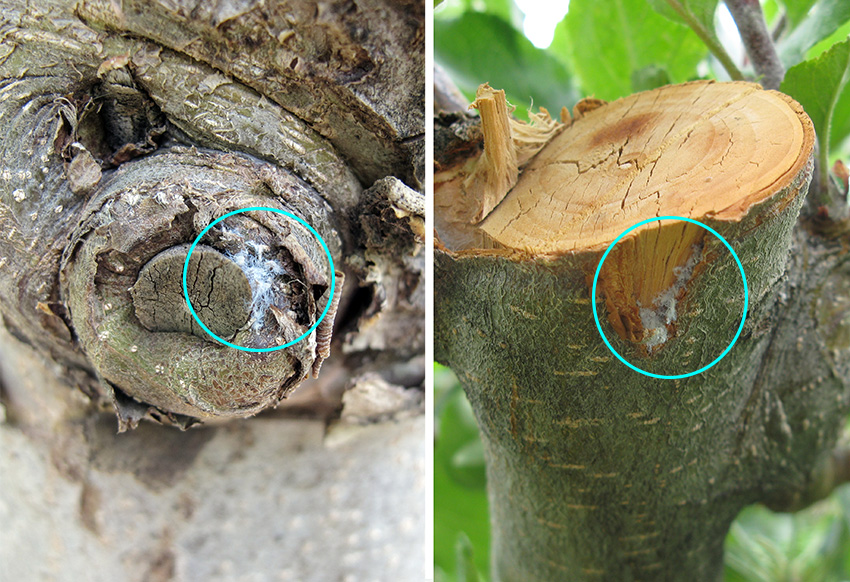
Woolly apple aphids have been found in all fruit growing areas of northern Utah. If your trees have lost their fruit, this pest should still be managed as it can weaken trees.
It is important to scout your own trees to determine when and if a treatment is needed. Start by looking for aphids around old pruning scars or other wounds, and on root suckers.
These aphids are different from typical aphid species in that they feed on twigs, bark and roots, and have a cottony covering on their bodies.
Once they are found, they should be treated rather than waiting.
Treatment
If “woollies” are a problem every year, it is best to treat them early. Because of the aphid’s thick, waxy coating, it is important to spray the tree (or target individual colonies) to drip, to reach the aphid bodies.
- Backyard growers can use insecticidal soap+1% oil (organic), or mix 1% oil with Spectracide Triazicide or GardenTech Sevin, aimed directly at the colonies.
- Options for commercial growers
PEACH/NECTARINE, APRICOT
Coryneum Blight
Recent rains will cause spread

If you do not have fruit, you do not need to spray for coryneum blight (shothole) until next fall.
If you do have fruit, coryneum blight is active and can cause infections during long-duration rains. Lesions look like purple spots that will become scabby over time. For the remainder of the season, new infections can occur when temperatures are warm (above 75) combined with a steady rain lasting 4 to 6 hours. A fungicide spray is required to prevent these infections from happening.
Treatment
Commercial growers – click here.
Residential – Spectracide Immunox, Monterey F-stop, captan, or Natural Guard Copper Soap (organic).
ALL FRUITS
Iron Deficiency
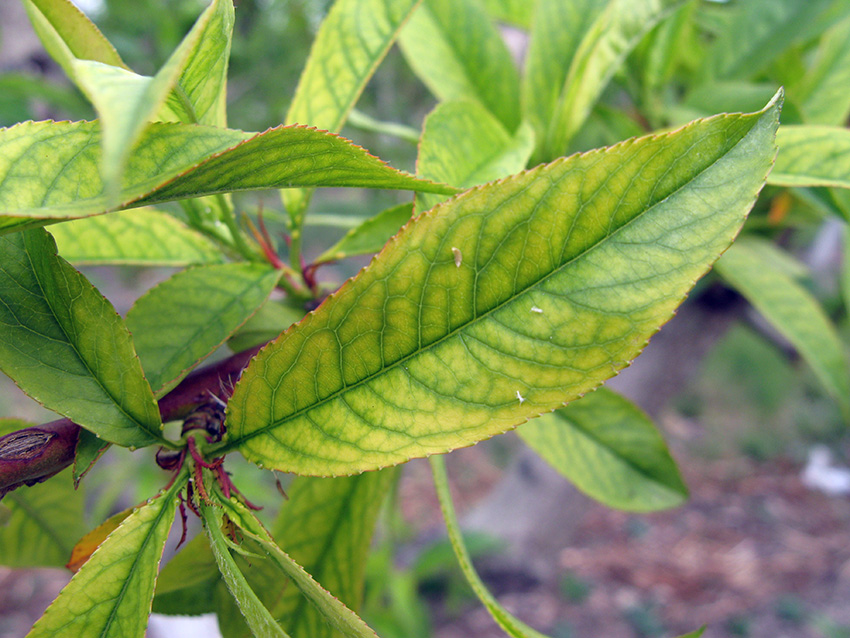
Iron deficiency is showing up in many fruit trees this spring. It is an issue that both commercial and residential growers have to deal with every year.
Iron deficiency causes foliage to become yellow between the veins, also known as iron chlorosis. It is not caused by a lack of iron in the soil, but rather the soil pH (which in Utah, ranges from 7.5 to 8.5). In high pH, iron is insoluble, and therefore not available for root absorption. Because irrigation water is also very alkaline, trying to manage iron deficiency by reducing soil pH is impossible.
Iron is a nutrient necessary for the formation of chlorophyll. Lack of chlorophyll means reduced photosynthesis, and reduced tree vigor. Some trees are genetically more susceptible to nutrient deficiencies than others.
Treatment
- To prevent or treat iron deficiency at this time of year, iron can be sprayed on the foliage. If it is not incorporated into the product, add a spreader-sticker. Reapply at approximately 10- to 21-day intervals.
- A better treatment is to apply chelated iron (which is not affected by soil pH and readily available for absorption) to the root zone in the spring before budbreak.
- Keep in mind that results are temporary and must be repeated each year.
- Residential growers can use Liquid Iron, Ironite, or other iron for foliar spray now. Next spring, use Miller’s Ferriplus, Sequestrene/Sprint 138, or Lily Miller Sequester for soil application.
- Commercial growers can use the above products, or see the Intermountain Tree Fruit Production website nutrition section.