

In this Issue
- Eggplant, pepper, and tomato: Tomato fruitworm moths will be laying eggs soon. Scout solanaceous crops (especially those by corn) and if larvae are found, apply an insecticide before they burrow into fruit.
- Cucurbits: Watermelon mosaic virus has been seen in cucurbits throughout Utah. Plants with the virus cannot be cured and should be removed to reduce the spread of disease. Aphids vector this virus, so control strategies should focus on managing populations early in the season.
- All Crops: Stink bugs can damage vegetable fruits close to harvest. Scout regularly for eggs, insects, and fruit damage. In the garden, handpick adults and in the field, control with an insecticide if economic thresholds are reached.
Tomato Fruitworm
Tomato fruitworm moths will be laying eggs soon. Scout solanaceous crops (especially those by corn) and if larvae are found, apply an insecticide before they burrow into fruit.
Crops Affected: Primarily eggplant, pepper, and tomato. Can also affect beans, peas, and corn.

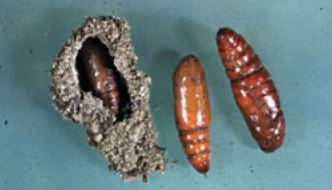

Symptoms and Life Cycle
Helicoverpa zea is known as tomato fruitworm (TFW) on tomatoes and other crops, and corn earworm on corn. TFW larvae chew holes in all plant parts. When fruit is present, larvae will often ignore the leaves and only feed on fruit. TFW bore deeply into the fruit to feed, resulting in watery internal cavities filled with cast skins and frass (feces). A single larva can damage several fruits during feeding and development.
In spring, adult moths migrate (or are blown) from warmer locations and by mid-June, females lay creamy white, dome-shaped eggs on host plants. The larvae have brown heads with green, brown, or black bodies and hatch in 2 to 10 days. Larvae feed for around 14 days and drop to the ground to pupate about 5 inches below ground. Adults emerge within 10 to 25 days to begin a second generation in August, followed by a third in September. Larvae of this generation may pupate inside fruits. In colder climates, most pupae of the third generation are killed: however, field with high levels of larvae in the fall tend to have higher levels of infestation the next spring. In southern Utah, the first flight occurs 3 to 4 weeks earlier, and there may be a fourth generation each year.


Management
- Monitor for moths by hanging bucket traps containing a pheromone lure specific to TFW along field perimeters. Traps provide an estimate of adult populations and peak activity.
- Monitor several plants in at least 4 locations starting mid-June or when moths are present in traps. Inspect leaves above and below the highest flower cluster for eggs and look for chewing damage on leaves. When fruit is present, check for damage and presence of larvae.
- Avoid planting tomato, pepper, and eggplant near corn fields. When corn silks turn brown, corn earworm/tomato fruitworm moths will seek out other nearby hosts for egg laying.
- Remove and destroy plant debris and culled fruits. Disk or plow plant debris, including weeds, to eliminate overwintering host sites and to destroy infested fruits and pupating larvae.
Use monitoring techniques to help determine when chemical control is needed. Although larvae may remain partially unprotected in the fruit and be exposed to insecticides when moving from fruit to fruit, it is best to target treatment toward newly hatched larvae before they enter the fruit in large numbers.
Click the following links in the Utah Vegetable Production Guide for tomato fruitworm spray options in commercial or small-scale production of solanaceous crops. In the PDF, reference pages 312 to 319 (Table 12.6) for commercial production and pages 325 to 328 (Table 12.8) for home gardeners.
Watermelon Mosaic Virus
Watermelon mosaic virus has been seen in cucurbits throughout Utah. Plants with the virus cannot be cured and should be removed to reduce the spread of disease. Aphids vector this virus, so control strategies should focus on managing populations early in the season.
Crops Affected: Primarily cucurbits. It is widespread in Utah watermelon and squash production and occasional in cantaloupe.


Symptoms and Life Cycle
Several viruses affect cucurbits in Utah, including cucumber mosaic virus and watermelon mosaic virus (WMV), with WMV being the most common. Mosaic viruses are named for the characteristic symptoms that they cause. A visual assessment can help to determine whether a plant may be infected, but viral diseases need to be lab-tested for accurate diagnosis.
WMV symptoms include stunted growth, leaf distortion and malformation, yellowing or light green mottling of leaves, and marginal chlorosis on foliage. The fruits are dwarfed, mottled, or spotted and frequently show color breaking and warts. The virus overwinters in infected perennial weeds or alfalfa. In spring, aphids acquire the virus when feeding on infected plants. Cucurbit plants on field edges are infected first, and aphids continue to move the virus across the cucurbit field. Aphids only harbor the virus for a short time, so transmission is non-persistent.
Beet curly top virus (BCTV) can also infect cucurbits. Symptoms of BCTV are quite distinct, with general yellowing of leaves rather than the mottled mosaic pattern of the mosaic viruses. It is transmitted by beet leafhoppers.


Management
- Monitor and control aphid populations starting in June to reduce the spread of the virus. Row covers put in place at planting through start of bloom can exclude aphid populations. Only use insecticide applications when needed. Rotate among different insecticide classes between applications as aphids are prone to developing resistance.
- Before planting, remove weeds and volunteer crops that can serve as aphid hosts. Throughout the season, control weeds around fields and gardens that may harbor the virus or house aphids.
- Avoid planting cucurbits next to alfalfa fields.
- If you suspect that your plant has a virus, contact the Utah Plant Pest Diagnostic Lab and send a sample to verify the infection ($30 for virus testing).
- Remove and destroy infected plants to reduce the spread of the virus.
Click the following links in the Utah Vegetable Production Guide for aphid spray options in commercial or small-scale production of cucurbits. In the PDF, reference pages 89 to 91 (Table 5.6) for commercial production and pages 94 to 97 (Table 5.8) for home gardeners. For more details on aphid management in vegetables, refer to this fact sheet.
Stink Bugs
Stink bugs can damage vegetable fruits close to harvest. Scout regularly for eggs, insects, and fruit damage. In the garden, handpick adults and in the field, control with an insecticide if economic thresholds are reached.
Crops Affected: Primarily tomatoes in Utah. Can also affect corn, cucurbits, eggplant, legumes, and pepper.


Symptoms and Life Cycle
The term ‘stink bug’ refers to a group of true bugs in the family Pentatomidae that can exude foul smelling odors from glands in their midsection. Stink bugs can be both carnivores and herbivores. The carnivorous or predatory stink bugs are considered beneficial, as they eat beetle larvae, caterpillars, leafhoppers, thrips, and more.
Beneficial predatory stinkbugs.


Herbivorous stink bugs feed with piercing-sucking mouthparts on fruits of vegetable crops. Tomatoes are the most commonly damaged crop where feeding causes hard, whitish callus tissue beneath the skin that changes to cloudy areas of hard yellow spots on the fruit surface. Damage on green tomatoes appears as dark pinpricks surrounded by a light-colored area. Stink bug feeding can also cause cat-facing and misshapen or shriveled fruit.
Stink bugs overwinter as adults under leaves or plant debris or in protected sites such as buildings, wood piles, dead trees, or weedy areas. They become active in the spring and can have 2 to 3 overlapping generations in a year. Eggs are laid in clusters of 10 to 30 eggs on the undersides of leaves. After 4 to 8 days (depending on species and weather) nymphs will emerge and begin feeding in a cluster around where they hatch. As they mature nymphs will disperse and continue feeding.


Management
Many species of stink bugs can be found in Utah, including the native green stink bug and the invasive Brown Marmorated Stink Bug. While many stink bug species look characteristic as adults, they are difficult to identify as nymphs. For help identifying different stink bugs, reference this fact sheet or contact the Utah Plant Pest Diagnostic Lab.
- Monitor for stink bugs by shaking foliage over a tray or onto the ground and counting the fallen nymphs and adults. Treatment thresholds will vary with plant types and intended use, but in general, an average of 0.5 stink bugs per tray shake will result in about 5% damage in tomato.
- Look for egg clusters on host plants along field edges starting in late spring and throughout the season.
- Eliminate weedy areas along field borders and within fields and gardens in the spring and late summer to avoid attracting stink bugs to vegetable crops.
- In the garden, handpick adults, nymphs, and eggs from plants and squish or dump into soapy water.
- Insecticide applications in commercial tomato fields are often necessary because of the low threshold. Adults are difficult to kill due to their strong flight capability and tolerance to insecticide residues. Target nymphs with chemical control options.
Click the following links in the Utah Vegetable Production Guide for stink bug spray options in commercial or small-scale production of solanaceous crops. In the PDF, reference pages 312 to 319 (Table 12.6) for commercial production and pages 325 to 328 (Table 12.8) for home gardeners.