

In this Issue
DECIDUOUS TREES
- Dormant oil application – timing depends on bud stage
- Sycamore Scale and Anthracnose – treat at budbreak
- Honeylocust pod gall midge – lays eggs at bud swell
- Boxelder bug – activity increasing
CONIFERS
- White Pine Weevil – Adults will soon begin climbing trees
DECIDUOUS TREES
Oil for Overwintering Insect Pests
What
The term “dormant oil” applies to the timing of application rather that the type of oil. Other terms are “horticulture oil,” “superior oil,” “mineral oil,” “spray oil,” “all seasons oil,” etc. They are all derived from highly saturated paraffinic petroleum or from plant sources, and refined to certain specifications. Most can be used during both the dormant and summer seasons (but the rate may differ).
- Petroleum-based oils – There are many brands, and they all work the same. Examples include All Seasons Horticultural Oil, Monterey Horticultural Oil, Gordon’s Dormant Oil Spray, Ortho Volk Spray Oil, Hi Yield Dormant Oil, etc.
- Plant-based oils – One example is Natria Multi-Insect Control (canola oil), but there are others. Neem oil is not as effective for the dormant application.
When
The dormant oil application can be applied anytime between the tree or shrub’s bud swell and the start of leaf emergence (budburst).

Use a rate of 2% to 3% oil in water. If leaves are more than half emerged, drop the concentration of oil down to 1-1.5%. Example mixes are:
- 2-3% mix is 2-3 gal oil in 100 gal water
- 2% mixture is 5 TBS oil per gal water
- 2.5% mixture is 6 TBS plus ¾ tsp per gal water
- 3% mixture is 7.5 TBS per gal water
Do not spray when temperatures are below 40° F, or when rain is predicted within 12 hours after application. The oil works immediately. When applied properly, there is little risk of plant damage.
How
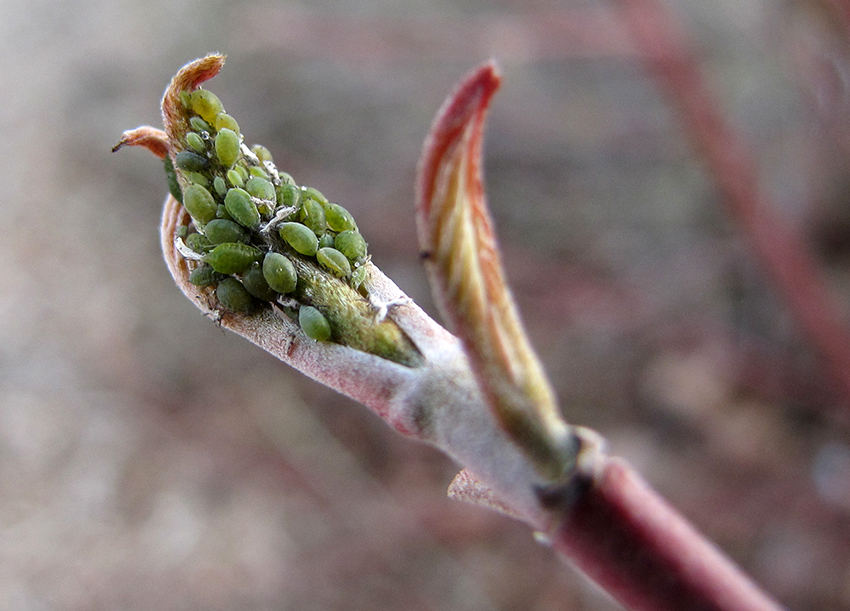
Dormant oil suffocates the overwintering insect stage (if it is susceptible). Examples of insects that would be affected are soft scales, aphids, and spruce spider mites. The overwintering stages of these insects start becoming “active” at the same time as bud burst, making them very susceptible to the oil application. At the same time, very few beneficial insects are active at this time, making this application a safe tool in pest management.
Some insects are not as susceptible to the oil application. Armored scales, such as oystershell scale or black pineleaf scale (Austrian, scotch pines) have a protective outer shell, and should be treated with a second application of oil or insecticide targeting their emerging crawlers (newly hatched eggs). The timing for these applications will be discussed in a later advisory.
Dormant Treatment for Sycamore Scale and Anthracnose
Where needed, apply fungicide plus oil application at the start of budbreak
Click on images for captions.
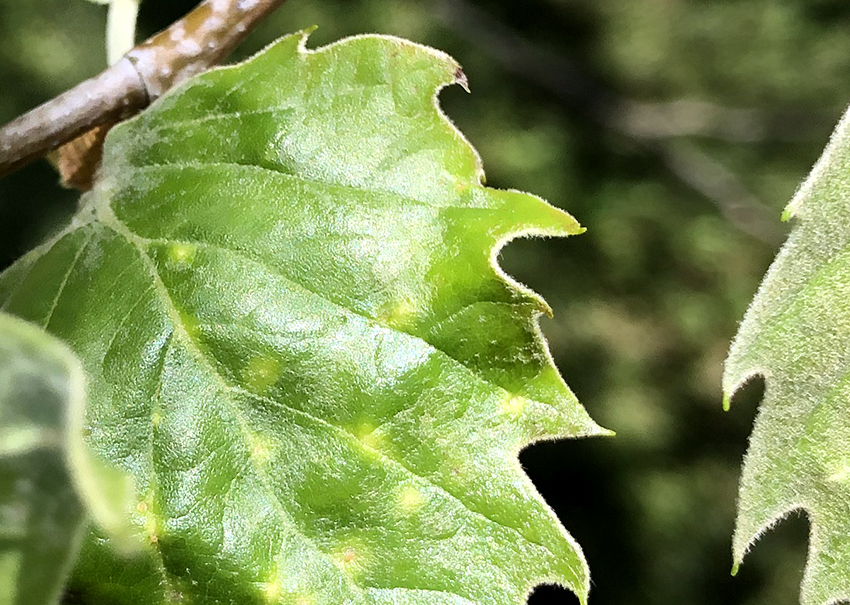
Sycamore Anthracnose
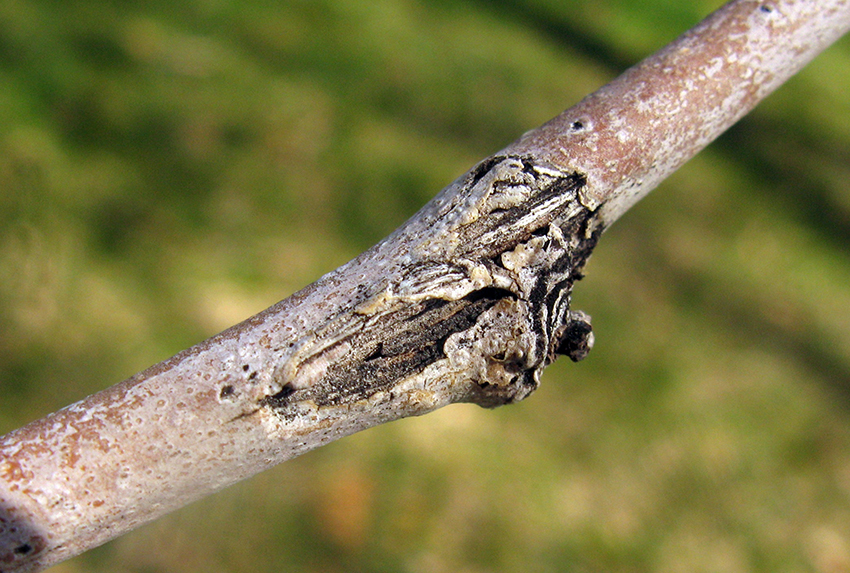
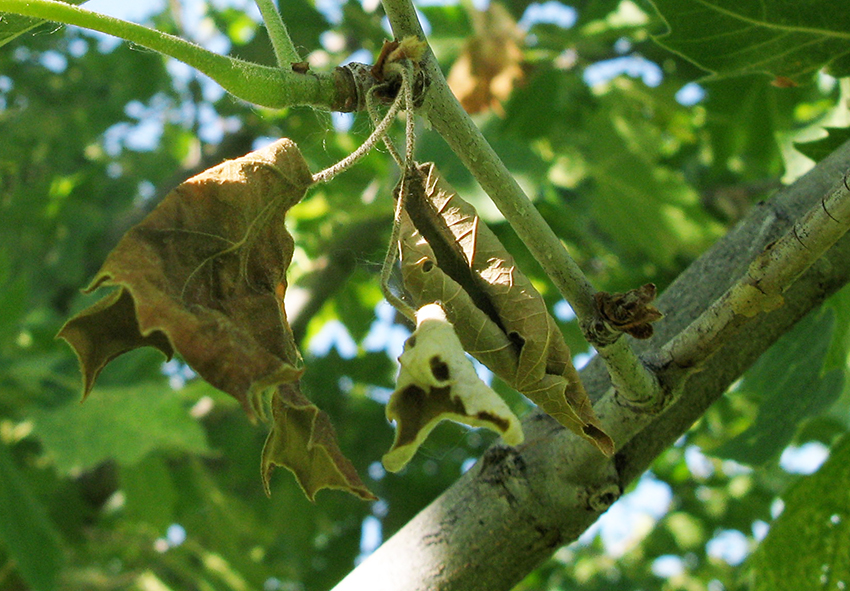
A fungal-caused disease that spreads quickly during cool, wet springs. The fungus invades the wood of twigs, causing small cankers, where it survives for the winter. In spring, spores emerge from these cankers, infecting new foliage as it emerges (under cool, wet conditions). Repeated infections can happen all spring until rains end and temperatures rise above 80F.
As a side note, there are anthracnose fungi that affect maple and oak, as well. This fungus overwinters in fallen leaves, so these diseases are the most severe in natural or wooded areas where the fallen leaves collect from year to year.
Anthracnose Treatment
- For all anthracnoses, apply a fungicide application at leaf emergence (chlorothalonil, tebuconazole or for homeowners, Spectracide Immunox) to reduce the incidence of infection.
- If cool, wet weather persists, a second or third application would be needed, spaced at 14 days apart.
- For specimen sycamore or London planetree, a fungicide trunk injection (Arborfos, Arbotect) provides protection for up to 2 years. Fall is the ideal time to apply, but spring also works.
Sycamore Scale
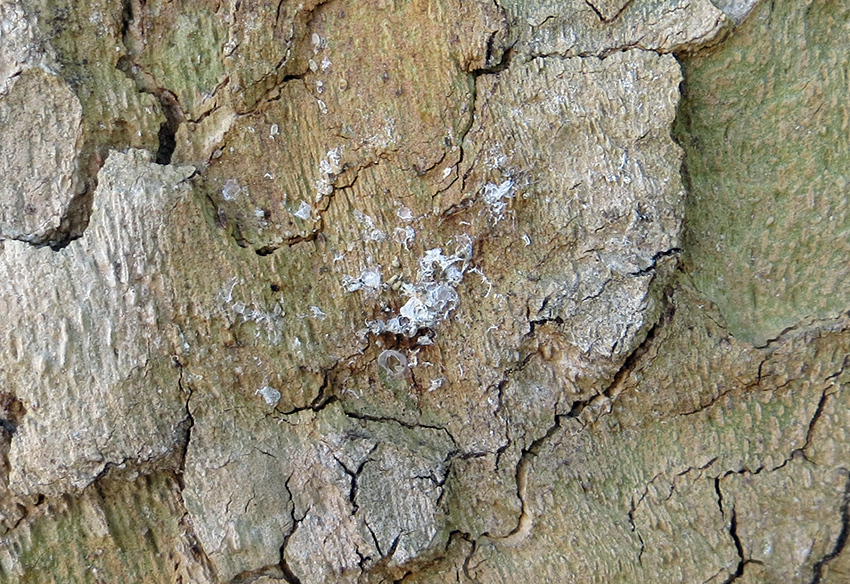
A pest that is native to the southwest U.S., including southern Utah and now occurs as far north as Davis County. This insect overwinters as waxy, cottony egg masses, under bark scales. Remnants of these egg masses can be seen in summer as a sign of the scale. Eggs hatch into crawlers in early spring as the tree breaks dormancy, working their way to the newly-expanding foliage. There, the scales settle onto foliage and feed and develop for the summer.
Individual scales are not visible to the naked eye. They can only be detected by their feeding on the foliage, which causes chlorotic (yellow) spots that eventually turn necrotic (brown). In addition, new summer foliage can be twisted and distorted and eventually leaf drop occurs.
Scale Treatment
- The ideal time to treat for scale is when the buds start to swell and the leaves just begin emerging (bud break).
- At this time, the crawlers are hatching from their overwintering sites on the bark and migrating to the foliage, so they are exposed.
- University of California-Davis entomologists tested multiple insecticides, and found that a spray of 2-3% horticultural oil was the safest and most effective option.
- At this spray timing, the oil will be able to penetrate through the entire tree and drip onto the bark to reach any unhatched eggs.
- Another option is trunk-sprayed dinotefuran (professional application).
Honeylocust Pod Gall Midge
Apply 2% oil or carbaryl right as leaves emerge to kill newly-laid eggs
Click on images for captions.
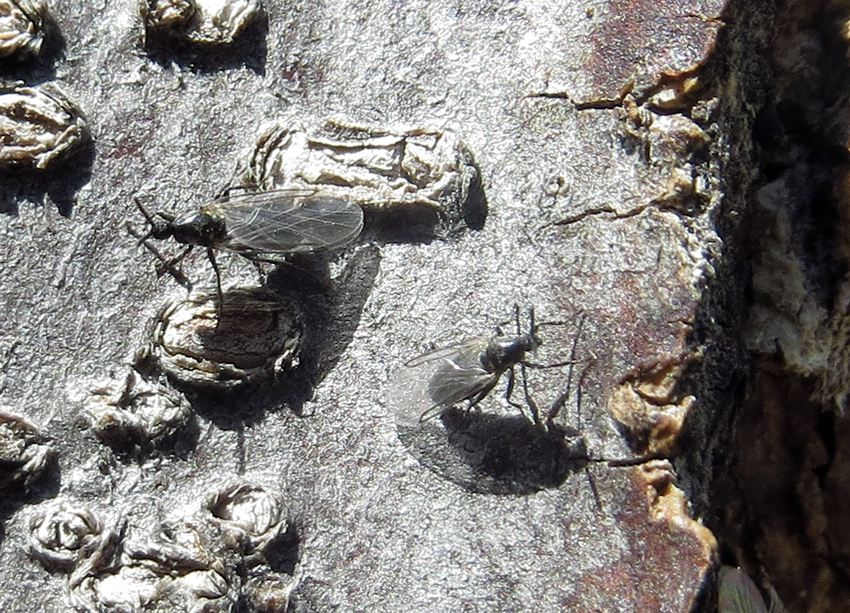
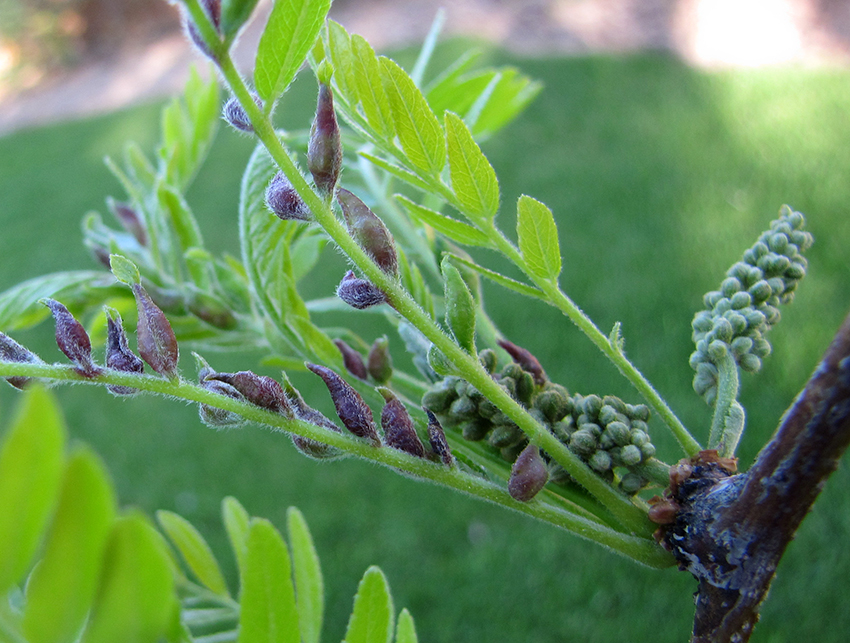
Honeylocust pod gall midge is a small fly that lays eggs on buds in early spring. The feeding of the newly hatched maggots causes swellings to form around them for protection. This is a fairly common pest in Utah.
Heavily infested leaves drop prematurely and when small branches die back, new shoots develop. There are several generations each year. Adult activity will increase as the buds start to swell and break, and you can look for them by shaking branches over a cloth tray.
Treatment
- Target the newly laid eggs with horticultural oil (2% rate) or carbaryl (Sevin) soon after bud break.
Boxelder Bug
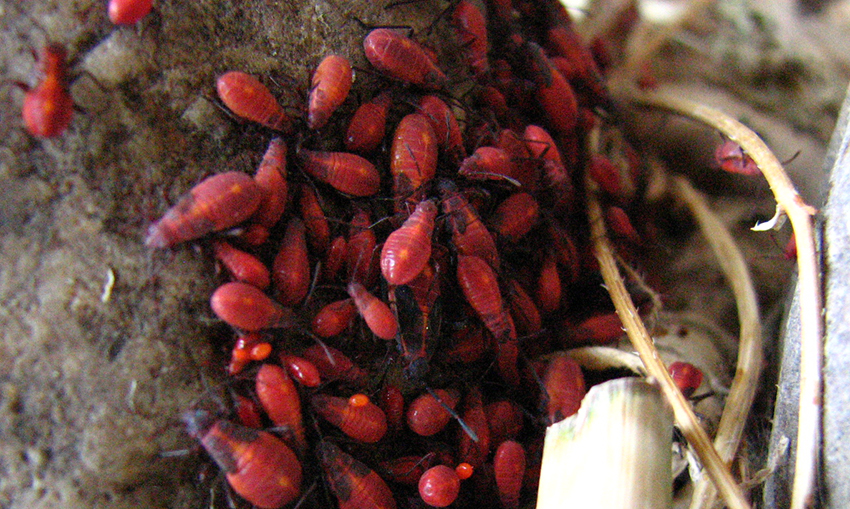
Boxelder bugs are slowly becoming active as the temperatures warm. They overwinter as adults in protected sites, sometimes within structures. They tend to congregate in sunny areas in early spring, such as on the south side of houses.
If you find them inside the home, the best option is to vacuum them. Eventually, the adults will migrate to hardwood trees (in particular boxelder and other maples) to lay eggs.
To get a head start on next fall, take the time this summer to seal all cracks and crevices where the bugs may gain entry into the house.
CONIFERS
White Pine Weevil
Target adults in the next few weeks

This insect will attack white pine, Austrian pine, blue spruce (shown), limber pine, scotch pine, Norway spruce, Douglas-fir, and others. It seems to be particularly troublesome in the Park City area.
Adults mate in fall and spend the winter near the soil surface. In early spring, they crawl up the host tree where they may feed at the top, or they fly great distances to the top of another host tree. They feed on tissue just below the terminal bud, and soon afterward, females lay their eggs within the feeding sites.
A single female can lay about 100 eggs on various host trees. The eggs hatch into white larvae that feed just under the bark for several months, eventually killing the terminal leader. As the leader dies, it typically forms a distinct crook that is indicative of the white pine weevil.
Trees are not killed by this pest, but those that are attacked year after year will be stunted and misshapen. (When the leader dies, a lateral branch curves upward and becomes a new tree leader.)
Treatment
- Where needed, apply a product containing permethrin to tree trunks and terminals in early spring (early April).
- At the first sign of wilting (in early summer), prune out the terminal leader to reduce insect population.