

In this Issue
- Delayed-dormant Sprays – applied before bloom
- Insect Spray Options – for insect eggs
- Disease Spray Options – for fire blight and peach leaf curl
- Images of Insects and Diseases Affected by a Delayed-Dormant Spray
- Pear Fruit Sawfly – controlled with insecticide before bloom
Utah’s winter 2026 was very disappointing – almost the warmest on record and one of the lowest snowpack years. We did have precipitation, just not in the form of snow. This means more insects and plant pathogens are able to survive the winter and will become active earlier in spring.
Delayed-dormant Sprays
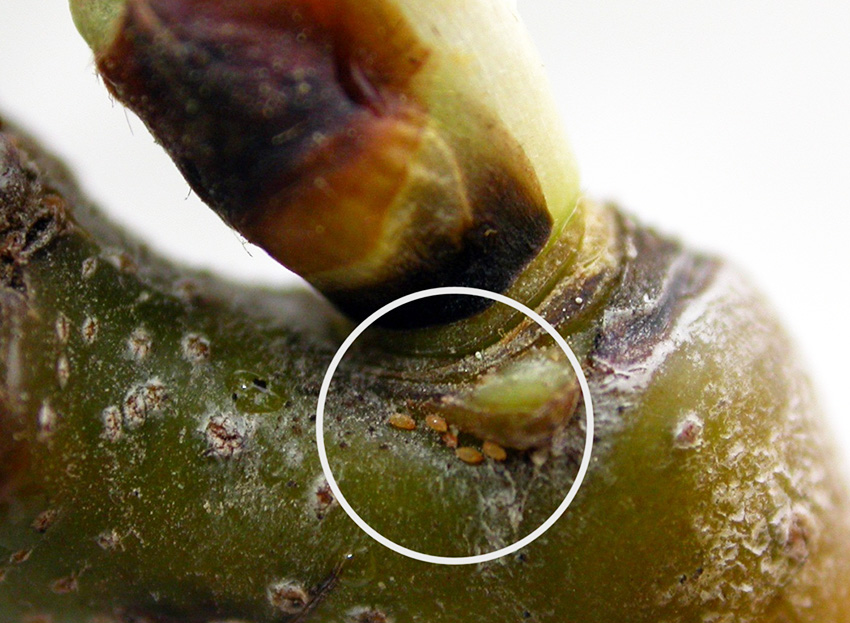
You are likely familiar with the term, “dormant spray,” but actually, the optimal timing for this spray is after trees break dormancy, but before bloom. In other words, the spray should be applied around the time when buds swell. The reason for waiting for bud-swell is that this timing matches up with the increasing activity of the overwintering insect stages, such as aphid eggs, scale nymphs, and peach twig borer larvae. If applied too early, the spray will not work as well on these pests.
The use of horticultural oil before bloom can target many insect pests (see images below, and see more explanation about oil below under “Backyard”).
In northern Utah, it is time to check out your tree’s bud stages, and make a decision on whether to apply the spray (if not done already).
When Should I Spray?
There are two factors to consider for determining when to spray: the bud stage of your fruit trees (pictures of fruit bud stages), and weather conditions.
Bud Stages
The window for application extends from bud swell to close to pre-bloom, usually a period of several weeks, depending on the tree.
The images below show examples of bud-swell (budburst). Your application should be applied in the range just before or soon after the buds of your trees resemble these.


The last point at which you can safely apply oil (at the recommended rate below) for each crop is:
- apple: half-inch green (ideally, application is made at green tip stage)
- cherry: white bud
- pear: green cluster
- peach/nectarine: just before first bloom (when the pink shows through the flower bud)
- plum: green cluster
Weather Conditions
- Only spray if temperatures remain above freezing (ideally above 40°F) for 24 hours after application.
- Ideally, spray on a clear, non-windy day in the 50° to 70°F temperature range.
- Do not apply if rain is predicted within 24 hours. This will help give the spray time to work.
Should I Spray at All?
If your fruit trees are affected by any of the pests shown in the image gallery below, apply the delayed-dormant spray. If not, you can skip this process!
Insect Spray Options
Oil Alone or Oil plus Insecticide
- An oil as an insect spray works by smothering eggs or other overwintering stages. There are plant-based oils and petroleum-based oils. For the dormant oil application, the petroleum-based oils work the best, although canola-based oil is another option.
- Petroleum-based oils – There are many brands, and they all work the same. Examples include All Seasons Horticultural Oil, Monterey Horticultural Oil, Gordon’s Dormant Oil Spray, Ortho Volk Spray Oil, Hi Yield Dormant Oil, etc.
- Plant-based oils – One example is Natria Multi-Insect Control, and neem oil is another option.
- Where oil alone has not worked as well for some pests (like aphids), adding in an inexpensive insecticide will make the delayed-dormant spray more effective.
Application – Commercial growers
- Oil should be applied at a rate of 2-3%, which is 2-3 gallons per 100 gallons of water.
- (Optional) Mix oil with an insecticide such as Warrior or Asana to help improve knockdown of overwintering pests.
- When spraying apple or pear trees, it is OK to mix in copper for fire blight.
- Thoroughly cover all cracks and crevices of the tree bark and buds.
Application – Backyard growers
- Oil should be applied at a rate of 2%, which is 5 Tbs in 1 gallon of water.
- If you are not growing organically, and aphids or scale have been a serious problem and oil alone has not worked in past years, consider mixing the oil with the appropriate rate of an insecticide, such as Spectracide Triazicide, GardenTech Sevin, or Malathion.
- When spraying apple or pear trees, it is OK to also mix in the proper rate of copper to help prevent fire blight bacteria from multiplying.
- Make sure you thoroughly cover all cracks and crevices of the bark and buds
Disease Spray Options
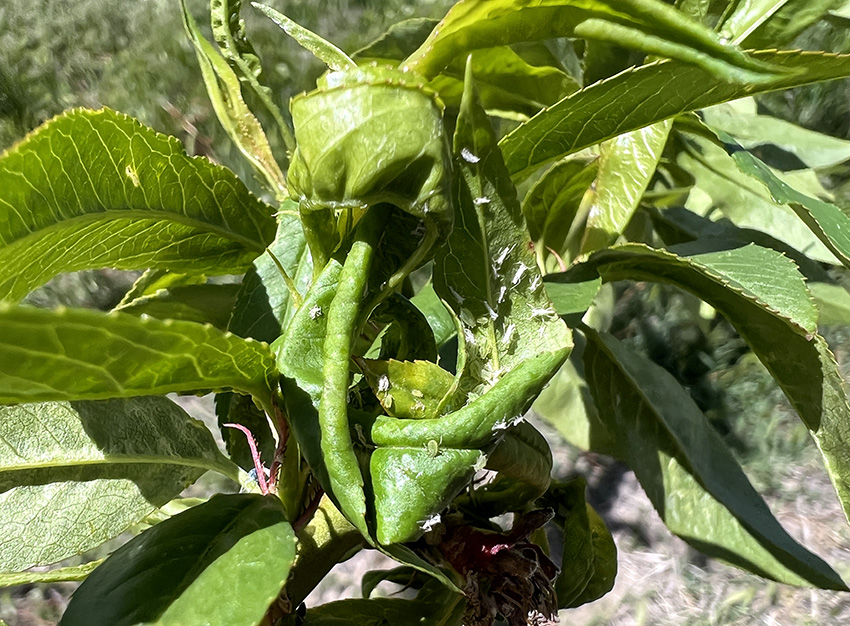
Apples and pears can be affected by fire blight (see image below). It is a bacterial disease that overwinters on and within bark. When the weather warms, the bacteria starts multiplying. Applying copper has been shown to prevent the bacterial from increasing in population size, and is a great tool to manage this disease. The table below provides some options for use. Again, copper can be mixed with the oil spray and applied together.
| Ingredient | Commercial Options | Residential Options | Comments |
|---|---|---|---|
| basic copper sulfate | Cuprofix; Basic Copper Sulfate; C-O-C-S | Effective, but should only be used before leaf emergence or in the fall | |
| copper oxide | Badge, Champ, Nordox | ||
| copper hydroxide | Kocide; Champ; Nu-Cop; Previsto | Previsto has a low copper concentration | |
| copper diammonia diacetate complex | Monterey Liqui-Cop | ||
| copper octanoate (soap) | Camelot, Cueva, Grotto | Gardens Alive Soap Shield; Bonide Liquid Copper Fungicide; Natural Guard Copper Spray; Espoma Copper Soap | Has lower metallic copper concentration; safer on plants; effective |
| copper sulfate pentahydrate | MasterCop; CS 2005, Instill, ET-F | Not as effective as a dormant application. | |
Peaches/Nectarines can be affected by two diseases that can be managed by the delayed-dormant spray: peach leaf curl and coryneum blight (see images below).
Coryneum blight is also known as shothole blight, and it affects apricots as well. Copper has been the main treatment option. However, scientists at Colorado State University have been researching a different disease (cytospora canker) and they discovered that the application of copper for shothole causes tiny wounds in the bark of peach trees. These wounds can then become infected by cytospora (gumming). So they have stopped recommending copper applications on peach, nectarine, and apricot trees.
- As an alternative to copper on peach/nectarine and apricot for shothole or peach leaf curl, use the same fungicide you would use during the growing season as your delayed-dormant spray. This can be mixed with the oil.
Some Insects and Diseases Affected by an Oil or Copper Spray
Click on an image for caption information.




Delayed-dormant Spray for Pear Fruit Sawfly

Pear fruit sawfly (Hoplocampa brevis) is an early spring pest that attacks young pear fruitlets. The adult is a small, fly-like wasp that is reddish-yellow in color. Females lay eggs inside flowers, and the hatched larva feeds exclusively within the developing pear for approximately six weeks from early to mid-spring. After this time, the insect goes into a dormant stage until the following spring.
Symptoms of pear fruits include:
- deformed and swollen shape
- blemished skin
- round hole located near the calyx, accompanied by black decay and wet frass
- premature drop
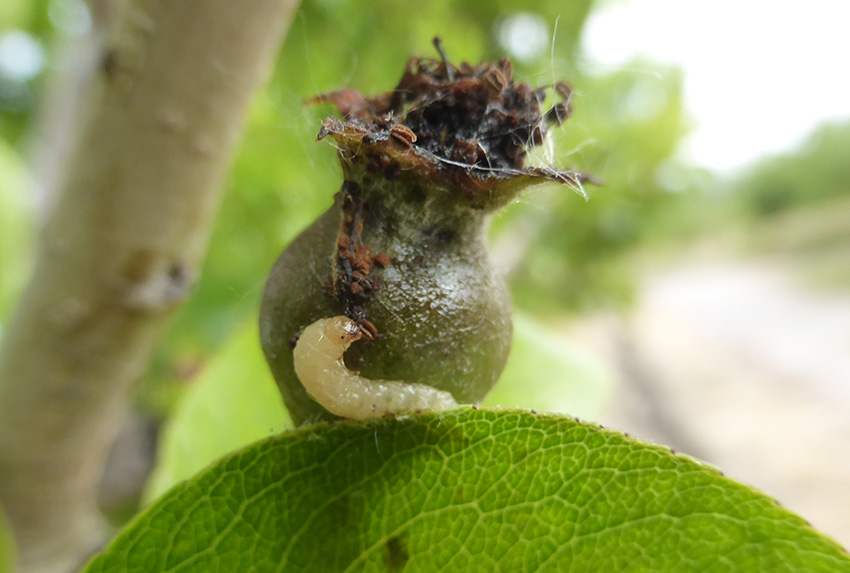
To distinguish pear fruit sawfly from codling moth, keep these factors in mind:
- symptoms of pear fruit sawfly will appear several weeks before codling moth
- sawfly frass is wetter and darker
- sawfly larvae are smaller, darker in color, and have 7 pairs of prolegs (as opposed to codling moth’s 5)
Several Utah locations have been affected by this pest, but the fruit injury will fluctuate from year to year. The insect population size and amount of damage depends upon the previous year’s damage level, whether adult flight is synchronized with pear bloom, the level of fruit set, and overwintering conditions.
If the crop load is high, anecdotal evidence suggests that damage from pear sawfly will be “absorbed” by crop thinning, and therefore, intervention may not be necessary. If the crop load is light, the injury could cause a greater negative impact.
Delayed-dormant Treatment
- Utah pear growers have found success with a single insecticide treatment applied just before bloom.
- They reported that the use of horticultural oil (2% rate) mixed with a broad-spectrum insecticide (such as carbaryl or a pyrethroid) labeled for pear, have reduced losses.
- Do not spray too early, or the treatment will miss the arrival of the adults seeking out flowers.